

Coastal Home Decor Styling Tips: A 2026 Guide
Posted by Editorial Team on Oct 18th 2026
Table of Contents
- Understanding Coastal Home Decor Styling
- The Coastal Color Palette for Home
- Natural Materials and Textures That Define the Style
- Modern Coastal Decor Ideas for Every Space
- Coastal Living Room Decorating Ideas
- Coastal Style Decorating Mistakes to Avoid
- Bringing It All Together: Your Coastal Home
- Frequently Asked Questions
Last Updated: October 17, 2026
Understanding Coastal Home Decor Styling
Coastal home decor styling brings the relaxed, breezy atmosphere of seaside living into any interior, regardless of where you live. At thomaspaul, we see it as more than nautical accents: it's a cohesive environment that feels calm, effortless, and connected to nature, built by layering soft colors, natural materials, and light-filled spaces intentionally rather than thematically.
The coastal home decor styling approach has evolved from literal beach-house design into a sophisticated, modern interpretation that works in urban apartments and suburban homes alike, respecting minimalism while embracing texture and prioritizing quality craftsmanship over mass-produced décor.
This guide covers core principles, room-by-room applications, mistakes to avoid, and sourcing pieces that feel authentic, with practical strategies that avoid cliché while delivering serene, seaside ambiance.
The Coastal Color Palette for Home
The foundation of any coastal home decor styling scheme is color drawn from nature: sky, sand, water, and weathered shore materials. What separates an authentically coastal room from a themed motel comes down to named colors, finish sheens, and the ratio in which you apply them.
Start with a dominant neutral that occupies roughly 60 percent of the visual field. Rather than generic 'white,' consider warm off-whites with a hint of yellow or gray, such as Benjamin Moore White Dove or Sherwin-Williams Alabaster. These read as soft and sun-washed rather than stark.
Your secondary color should occupy about 30 percent and typically lands in the muted blue or sage green family. Avoid saturated turquoise or navy as a secondary; save those for accents. A dusty blue like Benjamin Moore Boothbay Gray or a soft sage like Sherwin-Williams Sea Salt reads as coastal without shouting.
The remaining 10 percent is where accents live: deeper ocean blues, weathered driftwood grays, warm sand tones, and muted greens. This is where you can introduce a navy pillow, a piece of coral, or a ceramic vase in a deeper glaze.
Natural light dramatically shifts how colors read: a soft blue can turn gray in a north-facing room and near-white in a bright south-facing one. Test a 12-by-12-inch painted patch on the actual wall at morning, midday, and evening before committing, and bring fabric swatches home to view against your floors and lighting.
Finally, consider the finish of your surfaces. Coastal light is diffuse and reflective, so polished chrome or high-gloss lacquer can feel out of place. Instead, favor brushed brass, unlacquered brass that patinas over time, matte ceramics, and oil-rubbed bronze. These finishes catch light softly and reinforce the organic, weathered quality the palette is built to support.
Natural Materials and Textures That Define the Style
Coastal styling lives or dies by its materials. Rattan, linen, jute, reclaimed wood, and woven materials are non-negotiable because they echo actual beach environments and weather beautifully.
Rattan suits furniture frames, mirrors, and accents, developing a beautiful patina over time. Linen brings softness and breathability to upholstery, curtains, and pillows. Jute and sisal rugs ground a room and add warmth underfoot, while reclaimed wood, a coffee table, shelving, or wall accents, brings history and a weathered finish.
Layer textures: a smooth linen sofa with a chunky knit throw, woven jute rug, rattan side table, and driftwood shelf creates depth. Unlike high-gloss finishes or synthetics, natural materials develop patina that strengthens the coastal aesthetic rather than diminishing it.
Use rush rugs, straw hats, rope details, and shell or driftwood accents sparingly, as occasional punctuation marks that feel discovered rather than collected.
Modern Coastal Decor Ideas for Every Space
Modern coastal décor balances traditional beach-house ease with clean lines and contemporary sensibilities. Below are room-specific plans with measurements, layout guidance, and budget tiers so you can execute the look rather than just admire it.
Living room layout. Anchor seating with a rug extending at least 18 inches beyond the front legs of your sofa and chairs, typically 8-by-10 feet for a standard 10-by-12-foot zone.
Bedroom proportions. In a standard 12-by-12-foot bedroom, a queen bed (60 by 80 inches) should sit centered on the longest wall with 24 to 30 inches of clearance on each side for nightstands.
Budget tiers. A refresh under $500 might include a jute rug ($150-$250), linen-blend throw pillows ($30-$60 each), a woven basket ($25-$50), and a potted plant ($20-$40). A mid-tier update at $1,500-$3,000 could add a rattan side table ($200-$400), a linen slipcover ($300-$600), and a large framed abstract print ($150-$400).
Climate and durability. In humid coastal climates, choose moisture-resistant materials: teak and eucalyptus frames, solution-dyed acrylic outdoor cushions, and jute or sisal rugs treated with a stain and moisture barrier. Avoid untreated rattan in humid bathrooms or sunrooms, as it can warp.
Avoiding clichés. The most common mistake is treating coastal styling as a checklist of beach-themed items. Instead of a gallery wall of sailboat prints, choose one large abstract in ocean tones. Instead of scattered shells on every surface, group three to five shells of varying sizes on a single tray.
Coastal Living Room Decorating Ideas
The living room is where coastal styling comes together, your primary gathering space, which needs to feel both visually cohesive and genuinely livable.
Start with walls in soft white, pale blue, or warm neutral, or a muted blue-gray or sage green. Keep them simple so they serve as a backdrop for layered textures and accessories.
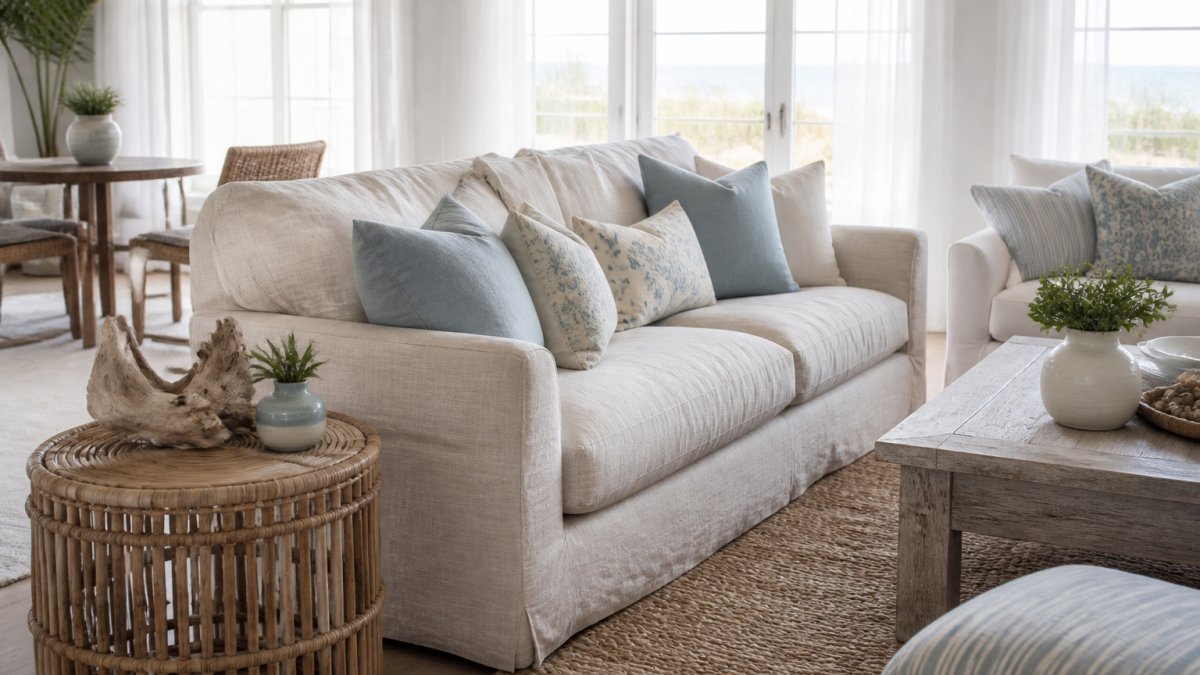
For furniture, prioritize comfort and natural materials. A linen upholstered sofa in cream or soft white serves as your anchor.
Lighting matters enormously. Combine natural light through sheer curtains with layered artificial lighting: a wooden or rattan pendant, table lamps with linen shades, and ambient floor lighting create warmth without harshness. Avoid anything too modern or industrial that clashes with the organic aesthetic.
Wall décor should be minimal but intentional: one or two large pieces, abstract artwork in coastal tones, a natural-framed mirror, or smaller pieces in matching frames work better than scattered items. Style a shelf with a potted plant, ceramic vessel, small stack of books, and perhaps driftwood or coral.
Coastal Style Decorating Mistakes to Avoid
The most common mistake is treating coastal styling as a checklist of beach-themed items to collect. This results in rooms that feel like novelty shops rather than livable spaces. Avoid literal sailboat art, excessive nautical signage, life ring wall hangings, or collections of shells and starfish displayed everywhere.
Overusing bold blues is another pitfall. Coastal styling works because it's predominantly soft, neutral, and calm; bold navy or bright turquoise overwhelms the space. Use deeper blue sparingly, one accent wall or a single piece of furniture, balanced with plenty of white and neutrals.
Don't neglect natural light. Coastal styling depends on brightness and airiness. Heavy curtains, dark paint, or cluttered spaces that block windows undermine the entire aesthetic. Keep window treatments light and simple. Sheer white or cream curtains diffuse light beautifully while maintaining privacy.
Avoid synthetics mimicking natural materials, plastic rattan, polyester linen, laminate "reclaimed wood." Natural materials develop character over time; synthetics just look worn out. Invest in genuine materials even if it means buying fewer pieces.
Clutter is the enemy. Coastal styling thrives on simplicity and breathing room. More isn't better; intentionality is. Curate your décor carefully. Each piece should earn its place through beauty, function, or meaningful connection.
Another common mistake is ignoring your actual climate and light conditions. The same soft blue looks completely different in a bright, south-facing room versus a dim, north-facing space, so test everything in your actual environment, what looks perfect in a showroom might feel off at home.
Bringing It All Together: Your Coastal Home
Creating a cohesive coastal home decor styling approach means thinking beyond individual rooms: consistent color palettes, repeated textures, and intentional transitions create wholeness rather than disconnected vignettes.
Start with your most-used space, typically the living room or bedroom, and perfect the coastal aesthetic there before expanding. The principles stay consistent: soft colors, natural materials, layered textures, abundant light, and careful curation.
Quality matters more than quantity. According to interior design research on sustainable home styling, spaces built on intentional, quality pieces create lasting satisfaction compared to rooms filled with trend-driven purchases. A few beautiful, well-made items beat dozens of mediocre ones.
Consider your sourcing strategy. Vintage markets, estate sales, and specialty retailers offer authentic pieces with history and character. New pieces work too, particularly handmade textiles and designer décor from brands like thomaspaul that prioritize craftsmanship. Mix vintage finds with new pieces to create depth and authenticity.
Document your inspiration with a mood board of paint chips, fabric swatches, and images you love. Reference it when shopping and decorating to prevent impulse purchases that don't align with your vision.
The coastal home decor styling aesthetic isn't about recreating a beach house if you don't live near the coast. It's about capturing the feeling, calm, spacious, connected to nature, uncluttered.
Coastal styling transforms how your home feels, but it requires intentional choices about color, materials, and curation. thomaspaul's collection of handmade textiles and designer décor pieces provides the foundation for authentic coastal styling, quality items designed with sophistication rather than novelty.
Frequently Asked Questions
How do you decorate a home in a coastal style?
Start by choosing a soft color palette of blues, whites, and sandy neutrals. Layer natural materials like linen, rattan, and reclaimed wood throughout your space. Incorporate seaside-inspired accents such as shells, driftwood, and rope details. Use reflective surfaces and mirrors to amplify light, and keep furnishings simple and uncluttered. The goal is to create a calm, breezy atmosphere that feels effortless and relaxed, as if you've brought the ocean indoors.
What colors work best for coastal home decor?
Soft blues, crisp whites, and neutral beiges form the foundation of any coastal color palette for home design. Layer in warm sandy tones, soft grays, and pale greens to add depth without overwhelming the space. These light colors reflect natural light and create the airy, open feel central to coastal aesthetics. Reserve darker accent colors for small touches, navy throw pillows or charcoal artwork, to prevent the space from feeling flat or washed out.
How can I make coastal decor look modern rather than beach-themed?
Modern coastal decor ideas focus on clean lines, minimalist furnishings, and subtle seaside references rather than obvious nautical motifs. Skip heavy sailboat prints and life ring decorations in favor of abstract coastal artwork and understated rope details. Choose contemporary furniture silhouettes in natural materials, and layer textures through pillows and rugs rather than filling shelves with beach memorabilia. This approach keeps the style sophisticated and timeless.
What materials and textures are common in coastal interiors?
Natural materials define coastal interiors: linen, jute, rattan, woven rush rugs, and reclaimed wood are foundational. Layer in organic finishes like woven baskets, straw hats as wall decor, and rope details on mirrors or shelving. These materials create visual interest and tactile warmth without requiring pattern or color. Combining smooth surfaces (polished concrete, light-colored floors) with rough textures (woven textiles, driftwood) achieves the relaxed, organic feel coastal style demands.
Can coastal decor work in a home far from the beach?
Yes. Coastal style is about creating a calm, light-filled aesthetic grounded in natural materials and soft colors, not geography. Bring the outdoors in by maximizing natural light, using plants and botanical elements, and incorporating natural textures. The seaside inspiration translates to any climate or location through color choice, material selection, and a focus on simplicity and breezy, effortless design rather than literal beach references.
What are common mistakes to avoid when decorating in a coastal style?
Avoid visual clutter by resisting the urge to fill every surface with shells, anchors, and nautical trinkets. Don't use overly bright blues or whites that feel sterile rather than calm. Skip heavy, dark furniture that contradicts the light, airy aesthetic. Overcomplicating with too many patterns or textures disrupts the relaxed vibe. Finally, don't neglect lighting, coastal style requires plenty of natural light and layered artificial lighting to feel authentic and inviting.