

How Can You Tell If Decor Is Really Handmade?
Posted by Editorial Team on Nov 1st 2026
Last Updated: November 1, 2026
Quick Summary
Authentic handmade decor shows evidence of a maker's hands: slight variation between pieces, uneven edges that look intentional, visible tool marks, and surface texture rather than a uniform glossy finish. Perfect, identical items are often a sign of machine production.
- Look for throwing rings and faint fingerprints on handmade pottery.
- Check the base and back of rugs, where hand-knotted construction shows clearly.
- Examine metal for shallow, varied hammer marks rather than mold seams.
- Ask the seller for close-up photos of the surface, back, and base.
- Remember that a handmade label alone does not prove the item was made by hand.
Table of Contents
- What Authentic Handmade Decor Looks Like
- How to Tell If Pottery Is Handmade
- How to Tell If a Rug Is Handmade
- How to Authenticate Decorative Art and Metalwork
- Reading Product Photos: What Images Can and Cannot Show
- Questions to Ask When Buying Handmade Decor
- Your Next Step: Checking Your Current Pieces
- Frequently Asked Questions
What Authentic Handmade Decor Looks Like
Handmade decor rarely looks perfect, and that is usually the first clue.
Here is the core idea: handmade pieces show evidence of a maker's hands. Mass-produced pieces show evidence of a machine.
Look for these visual signs first:
- Slight variation between items in the same collection
- Uneven edges, lines, or spacing that feel intentional, not sloppy
- Surface texture you can see and feel, not a uniform, glossy finish
Most people assume handmade means flawless. It does not.
Definition: Handmade decor is an item shaped, finished, or decorated largely by hand, using simple tools rather than full automation.
How to Tell If Pottery Is Handmade
Pottery is one of the easiest categories to check, because clay leaves a clear record of how it was formed. If you want to know how to tell if pottery is handmade, start by looking at the form and the surface.
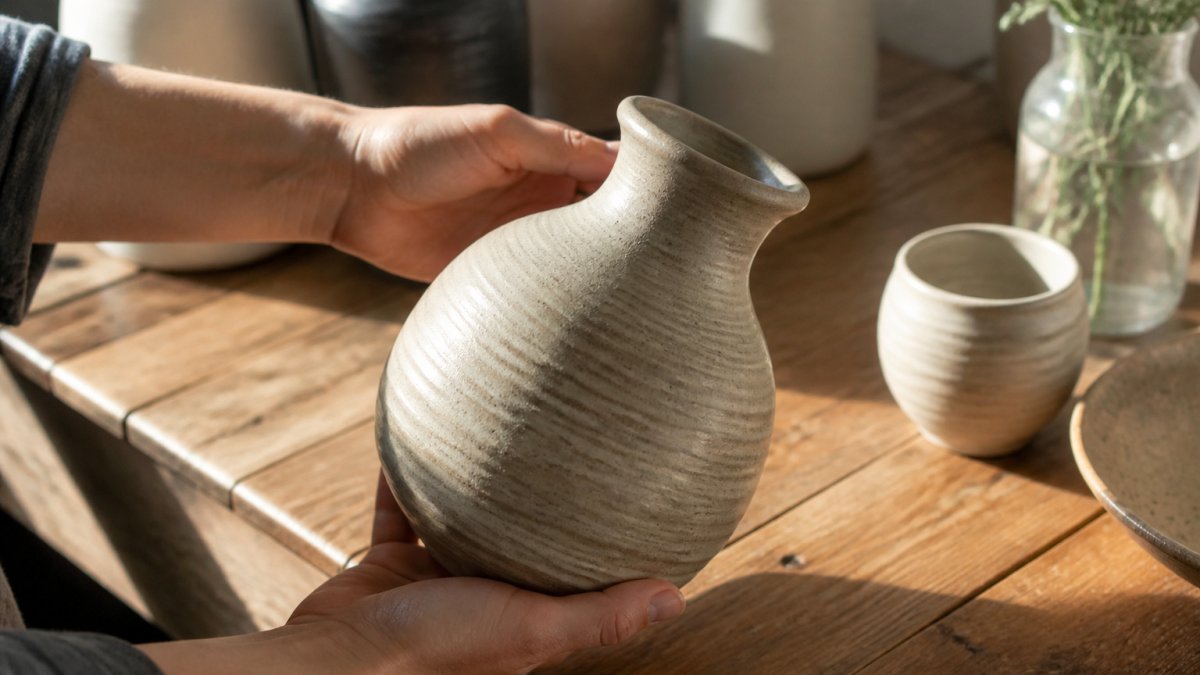
Handmade pottery is usually made by throwing on a wheel, hand-building with coils or slabs, or pressing into molds by hand. Each method leaves its own clues.
Checking Tool Marks and Throwing Rings
Turn the piece over and look at the base and the walls. Many thrown pieces show faint horizontal lines called throwing rings. These rings come from the potter's hands moving the clay on the wheel.
Tool marks are also useful evidence. Look for:
- Small scrape marks left by a trimming tool on the base
- Faint fingerprints or thumb impressions in the clay
- Gentle wobbles in the rim or lid fit
Machine-made pottery tends to have smooth, even walls and bases with no unique marks.
Inspecting Glaze and Surface Finish
Glaze is another strong indicator. Handmade glaze often pools slightly in low spots, breaks at the rim, or shows subtle shifts in color. Two pieces from the same batch may look slightly different, and that variation is normal.
Ask yourself these questions:
- Does the color change slightly across the surface?
- Are there small bubbles, pinholes, or drips that look natural?
- Does the glaze stop unevenly near the foot ring?
If every piece in a set looks identical under the same light, take a closer look at how it was made.
Use these pottery checks to judge whether a piece was made by hand.
| Check | Look for | Machine sign |
|---|---|---|
| Throwing rings | Faint horizontal lines on the walls | Smooth, even walls |
| Trimming marks | Small scrape marks on the base | Clean, uniform base |
| Fingerprints | Faint thumb or finger impressions | No unique marks |
| Rim and lid fit | Gentle wobbles | Perfectly even fit |
| Glaze | Slight colour shifts and pooling | Identical finish across pieces |
How to Tell If a Rug Is Handmade
Rugs are harder to judge from a photo, but the same logic applies. A handmade rug is typically hand-knotted or hand-woven, and its imperfections tend to follow a pattern you can see up close.
Check these features:
- Irregular edges: Hand-woven rugs often have slightly wavy borders.
- Pattern variation: Motifs may shift a little from one side to the other.
- Back side: The back of a hand-knotted rug shows the knots clearly. Uniform, glued-on backing often signals machine tufting.
A rug that looks perfectly printed, with no texture and identical edges on both sides, is worth questioning.
How to Authenticate Decorative Art and Metalwork
Decorative art and metalwork give you some of the clearest physical evidence of handwork, because both materials record how they were shaped. The trick is knowing which marks are supposed to be there and which ones signal a mold, a stamp, or a printer.
Metalwork: Reading Hammer Marks and Joints
Hand-raised and hand-planished metal carries a record of the maker's hammer. On copper, brass, and steel, look for shallow, overlapping dents that vary in size, depth, and spacing.
Machine-made or cast metal looks different in specific ways:
- Cast pieces show a uniform surface with seam lines where the mold halves met, plus ejector-pin marks or a sprue scar on the underside.
- Stamped or spun pieces show perfectly even wall thickness and concentric rings that repeat at a fixed interval.
- Hand-forged pieces often show slight asymmetry, a thicker section where the metal was drawn out, and hammer marks that stop and restart rather than tiling in a grid.
Turn the piece over.
Patina is another tell. Natural patina builds unevenly in recesses and along handling points; applied finishes tend to be uniform and can look painted into the low spots.
Paintings, Prints, and Painted Decor
For paintings, the surface itself is the evidence. Raking light across the canvas or panel reveals impasto, ridges of paint where the brush or palette knife lifted, and canvas weave that shows through thin passages.
For prints, ask which process was used and check the sheet edges.
For painted wood, tin, or ceramic decor, look for brush direction changes, small ridges at the edge of a stroke, and slight color shifts where the artist reloaded.
A Quick Cross-Category Checklist
Because the same logic applies across materials, run every piece through this short list before you decide:
- Base and back: tool marks, seams, mold lines, signatures, or stamps.
- Surface under raking light: texture, brush or hammer evidence, glaze pooling.
- Edges and joints: hand-cleaned versus machine-finished.
If a piece passes the visual checks but the seller cannot describe how it was made, that gap matters more than any single mark. Visual evidence and a credible production story should agree.
Reading Product Photos: What Images Can and Cannot Show
Most buying decisions for handmade decor now start with photos, so it helps to know exactly what an image can prove and what it cannot. Good photos can confirm shape, color relationships, and some surface detail. They cannot confirm weight, true texture, smell, or how a piece feels in your hands, and they cannot prove who made it.
What Photos Can Reliably Show
- Consistency across angles: Several photos of the same item from different sides should agree on shape, color, and detail placement. If the grain, glaze, or pattern shifts between shots in ways that do not match a single object, the images may be of different pieces.
- Close-ups of evidence: Tool marks, glaze pooling, knot structure, and hammer dents are visible in a tight, well-lit close-up. Ask for one.
- Lighting variation: The same piece photographed in daylight and in warm indoor light reveals how the finish behaves and whether color is stable.
- Scale cues: A photo with a hand, a ruler, or a known object in frame gives you real proportions. Without a scale cue, size is a guess.
What Photos Cannot Prove
- Weight and density: A heavy, solid piece and a hollow resin copy can look identical online.
- True texture: Fine surface feel, the difference between a matte hand-rubbed finish and a sprayed one, often only reads under direct, raking light in person.
- Smell and material identity: Natural materials like wool, linen, and solid wood have distinct smells and heft that no image captures.
- Maker attribution: A photo cannot confirm who made an item. Only documentation, a signature, or a verifiable maker story can.
Image-Only Verification Steps
When you are evaluating a listing remotely, a few practical steps close much of the gap:
- Run a reverse-image search. Save the product photo and search it through a reverse-image tool. If the same image appears on unrelated storefronts, marketplaces, or stock-photo sites, the listing may be reselling a generic product rather than a maker's own work.
- Compare the photo set for internal consistency. Backgrounds, props, and lighting should be consistent with a single photo session. Mismatched backgrounds across a "collection" can indicate images pulled from different sources.
- Look for the maker's process in the frame. A workshop background, tools, or work-in-progress shots are stronger evidence than a styled studio shot alone.
- Request specific new photos. Ask for a close-up of the base, the back, and the item next to a ruler. A seller who can produce fresh, specific images is more likely to be describing their own product.
- Check the description against the image. If the text claims hand-thrown pottery but the photo shows a perfectly uniform rim and a mold seam, trust the image over the copy.
Closing the Gap with the Seller
Photos get you most of the way, but a short exchange with the seller covers what images cannot. Ask for the three shots above, ask who made the piece and where, and ask whether the item in the photo is the exact item you will receive. That last question matters on marketplaces where a listing photo may represent a batch rather than a single piece.
Questions to Ask When Buying Handmade Decor
Before you buy, ask the seller a few direct questions. A reputable maker or retailer will answer them clearly.
Useful questions include:
- Who makes this piece, and where is it made?
- What process or tools are used in production?
- Are the pieces made one at a time, or in small batches?
- Can you share close-up photos of the surface and back?
A clear, specific answer builds more trust than a polished product page. If the seller avoids these questions, treat that as a warning.
Watch out: a "handmade" label alone does not prove the item was made by hand. Ask how it was produced before you pay.
Your Next Step: Checking Your Current Pieces
Start with what you already own. Pick one piece, examine its base, surface, and edges under good light, and compare it against the signs covered here.
When you are ready to shop, look for thomaspaul pieces that show these qualities. For current prices and production details, visit the thomaspaul website or contact the team before you buy.
Frequently Asked Questions
How can you tell if pottery is handmade?
Look for irregularities that machines rarely produce: slight asymmetry in rim height, faint throwing rings or wheel lines on the interior, and variation in glaze thickness that pools in certain spots. Check the base for a trimmed foot and tool marks where the piece was cut from the wheel. Uniform wall thickness, identical repeated shapes across a set, and a perfectly even glaze usually point to molding or slip casting. When a seller provides close-up photos of the base and interior, compare several pieces from the same listing to see whether the variation is consistent with hand production.
How do you authenticate a piece of decorative art?
Start by examining the signature, the materials and the construction. Hand-applied decoration often shows brush or tool strokes that vary in pressure and direction, while printed reproductions show a uniform dot or pixel pattern under magnification. Ask the seller for provenance documents, prior exhibition or sale records, and the name of the maker. Verify any claimed maker through independent sources such as gallery records or published catalogs. For significant purchases, consider an independent appraisal from a qualified appraiser before you pay.
What questions should you ask a seller about handmade decor?
Ask who made the piece, where the workshop is located, and whether the maker produced it personally or through a studio team. Request details on materials, finishing methods and typical production time. Ask whether the item is made to order or stocked, and whether the seller can share photos of the maker at work. Reputable sellers answer these questions directly and can name their production partners. Vague answers or a refusal to name the maker are reasons to look elsewhere.
Can you tell handmade decor from photos alone?
Photos can reveal useful clues, such as texture, tool marks and color variation across a set, but they cannot confirm how an item was made. Lighting, editing and filters can hide or exaggerate irregularities. Request several additional angles, including the base, interior and close-ups of finishes, and compare them for consistency. Treat image-only evaluation as a screening step, then verify claims directly with the seller before purchasing.
